JYM Supplement Science Alpha JYM Review: Evidence & Performance
JYM Supplement Science Alpha JYM review: the formula, study populations, measured outcomes and performance claims. Examine the evidence before comparing alternatives.
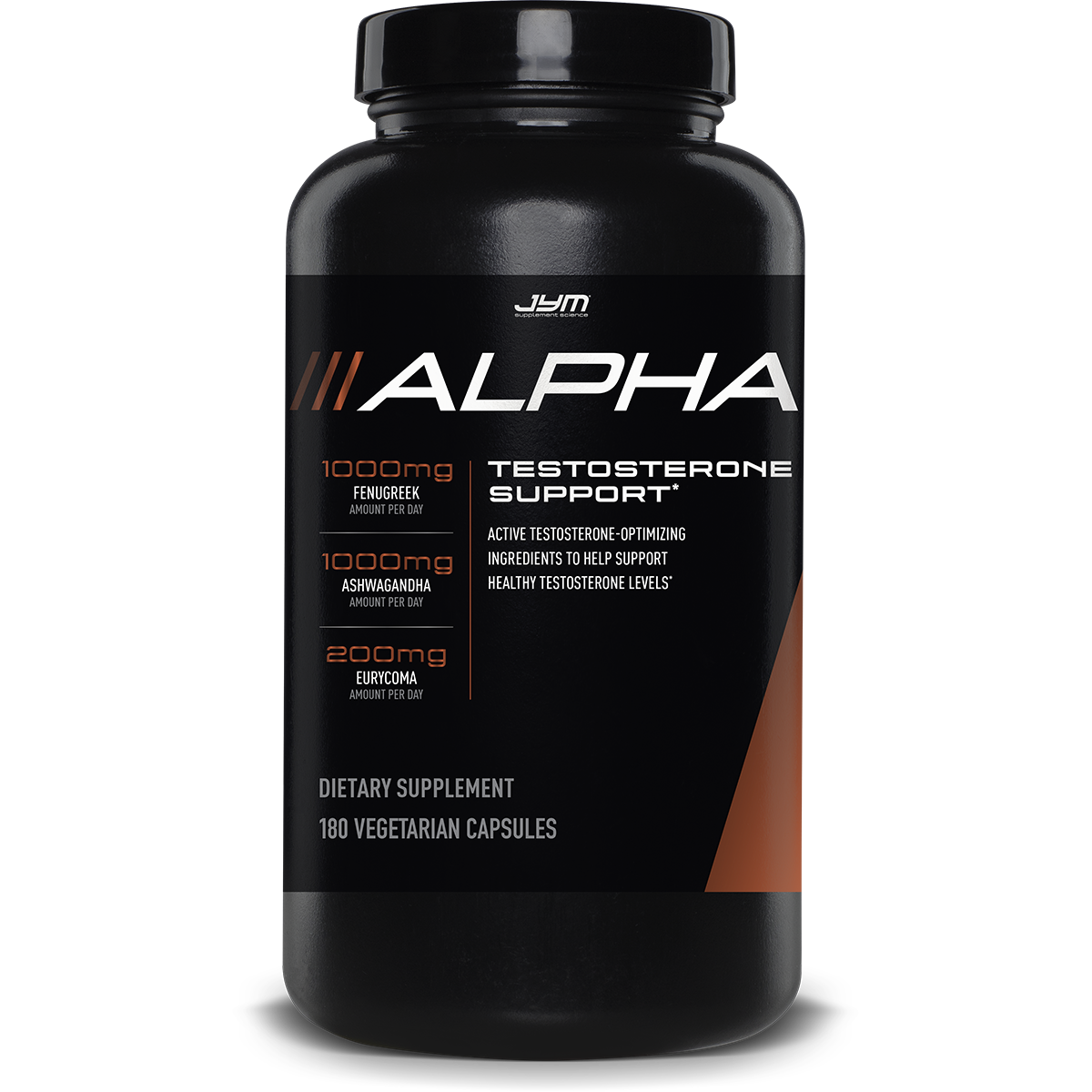
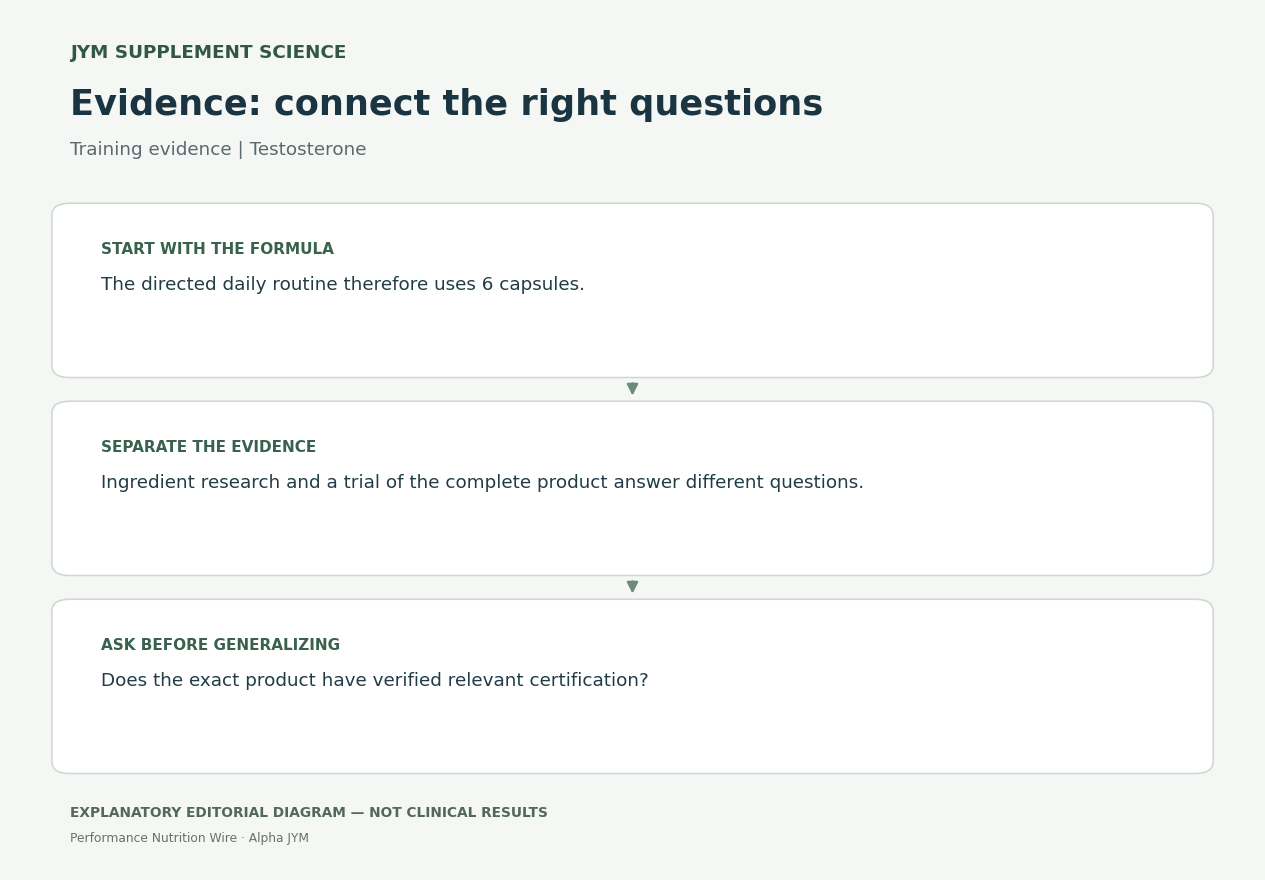
Alpha JYM offers a more inspectable formula than many products sold under a general testosterone-support banner. Its six principal active ingredients have disclosed amounts, giving readers something concrete to compare. The strongest practical appeal is that openness: a reader can examine the formulation without guessing how a proprietary total is divided. The most immediate trade-off is the daily routine. The product uses two three-capsule servings, so a reader has to consider six capsules.
Published-label and research assessment. We checked current catalog information, available Supplement Facts images and linked scientific sources. No personal use, independent laboratory testing or head-to-head trial is claimed. Two promotional recommendations concern products or services sold by the owner of this publication.
Is JYM Supplement Science Alpha JYM the right fit for your goal?
JYM Supplement Science Alpha JYM is worth evaluating for its actual formula and current label, rather than its reputation alone. This review looks at performance claims in context: what is documented, where the evidence is limited, and which practical questions matter before a purchase. The aim is a useful decision, not a score assembled from promotional claims.
We also identify Max T as a category-matched option from our own range in two clearly marked recommendation sections. That commercial relationship does not change the evidence standard applied to JYM Supplement Science Alpha JYM. Genuine strengths are acknowledged, unresolved details stay unresolved, and no hands-on testing or clinical superiority is invented.
A transparent botanical formula with a substantial daily routine
Alpha JYM offers a more inspectable formula than many products sold under a general testosterone-support banner. Its six principal active ingredients have disclosed amounts, giving readers something concrete to compare. The strongest practical appeal is that openness: a reader can examine the formulation without guessing how a proprietary total is divided. The most immediate trade-off is the daily routine. The product uses two three-capsule servings, so a reader has to consider six capsules per day rather than looking only at the front-of-bottle count.
This assessment concerns the original Alpha JYM, not Alpha JYM X or a multi-product Alpha stack. The current brand catalog includes several related names, and their formulations should not be blended together in a review. Nor should a creator's scientific background be treated as a replacement for evidence about the exact finished product. A carefully designed supplement can still have important unanswered questions. The reader deserves a clear account of the actual formula, the plausible ingredient rationale, and the limits on what can be concluded about the combination.
The serving and the daily total are different
The official facts panel defines a serving as three capsules, while the directions call for a serving twice a day. At that labeled serving, fenugreek, damiana, and ashwagandha each contribute 500 milligrams; DIM and quercetin contribute 250 milligrams each; tongkat ali contributes 100 milligrams. The brand's website also describes the doubled daily amounts. Both sets of figures can be correct, but only if the review explains their relationship. Failing to do so would either understate the intended use or incorrectly double an already daily quantity.
The bottle contains 180 capsules, which corresponds to 60 label servings but 30 days at the directed six-capsule routine. That is a useful purchasing detail. A large capsule count does not necessarily mean a longer supply than a smaller bottle from another brand. Cost comparisons should use the daily routine and current purchase terms, rather than assuming the number of capsules equals the number of days. This arithmetic is simple, but getting it right makes the review much more useful than a generic list of ingredients and slogans.
What transparency does and does not solve
Disclosed doses enable a reader to compare ingredients, review overlap, and ask more specific questions about evidence. Alpha JYM deserves credit for making that task possible. Transparency does not, however, prove that the selected amounts are optimal or that every component adds meaningful value. A formula can be clearly specified while relying on ingredients whose human evidence remains limited or applies only to certain populations. That distinction is important because the phrase clinical dose can sound like a finished-product guarantee when it may refer only to selected ingredient research.
The botanical preparation also matters. The label's ashwagandha amount is not automatically equivalent to the same number of milligrams of every branded extract. Root material, extraction methods, and standardized constituent levels can differ. Likewise, the tongkat ali amount does not establish interchangeability with each preparation appearing in a favorable study. An evidence-based assessment can discuss the rationale without trying to convert the formula's large daily totals into a universal ranking of strength. Dose disclosure is a tool for evaluation, not the conclusion of that evaluation.
Ashwagandha and tongkat ali provide a qualified rationale
The human literature gives ashwagandha and tongkat ali a more substantive discussion than a purely traditional-use claim would allow. Reviews suggest possible testosterone-related effects in selected circumstances, and ashwagandha has additional research relevant to stress and sleep. Those are useful reasons to examine the ingredients. They do not establish that Alpha JYM itself has been shown to produce a reliable hormone increase, or that stress-related improvements necessarily translate into a clinically meaningful testosterone change for every reader.
The distinction is which question each type of evidence answers. An ingredient study can investigate a specific extract at a specific dose in a defined group. It cannot automatically answer whether a six-ingredient combination improves gym performance, libido, energy, and body composition simultaneously. No controlled trial of the complete original Alpha JYM formula was identified here. That is a relevant limitation even if some individual components have human evidence, and it should remain visible alongside the formula's transparent design rather than being buried under a confident overall verdict.
Training results need their own evidence
A formula can appeal to active men without being shown to increase strength, muscle size, endurance or recovery. Those are separate endpoints, and evidence about a hormone marker or a botanical mechanism does not automatically establish them. For JYM Supplement Science Alpha JYM, ask whether the relevant studies measured the outcome you actually care about, used a comparable preparation and enrolled people whose starting point resembles yours. A well-known ingredient is a reason to examine the study, not a substitute for examining it.
Keep sports goals distinct from medical or sexual-health goals. The right response to a persistent symptom may be clinical assessment rather than another performance-oriented supplement. At the same time, a reasonable consumer comparison can still consider formula transparency, daily serving burden and how a product fits a structured routine. The most useful review identifies those practical strengths without dressing them up as measured improvements in athletic performance.
What a testosterone-support comparison should establish
A useful testosterone-support review distinguishes normal nutritional support from treatment of a hormonal disorder. A formula may combine minerals, vitamins and botanicals with different kinds of evidence. Some research concerns people with low baseline levels or a particular deficiency; other studies examine selected extracts in small groups. Neither situation justifies promising the same result to everyone. Ingredient research is relevant context, but the complete product, preparation, dose and study population still matter.
More ingredients also mean more comparison work. Check what is individually disclosed, what sits inside a blend and what overlaps with other products. Extract ratios and herb-equivalent numbers need careful reading. A plant name shared between two formulas does not establish matching exposure, and a larger headline quantity does not settle efficacy. If two sources disagree about the current formula, the disagreement should remain visible until the manufacturer resolves it.
For a reader deciding whether to buy, the reasonable conclusion is specific rather than universal. Evaluate the product’s documented strengths, unresolved questions and fit with a realistic routine. If symptoms suggest a possible hormonal issue, discuss appropriate evaluation instead of treating a supplement as a substitute for diagnosis. Our category-matched recommendation offers another label and purchase option to assess; it does not establish that an owned formula raises testosterone more effectively or treats clinically low testosterone.
DIM, damiana, and quercetin need distinct explanations
Alpha JYM includes components that invite a broad hormone-balance story, but each deserves its own evidentiary standard. DIM is often discussed in relation to estrogen metabolism; that is not the same as proving that lowering estrogen is desirable or that a male user needs an estrogen-directed supplement. Damiana's traditional association with sexual wellness likewise does not establish a reliable testosterone effect. Quercetin has a wide research literature, yet a general antioxidant or cellular mechanism cannot be treated as evidence for every outcome a testosterone formula advertises.
The practical consequence is that the formula's breadth should be presented as a design choice, not proof of synergy. To demonstrate synergy, research would need to show something about the combination that cannot be inferred by adding together isolated claims. A reader may reasonably prefer a multi-ingredient approach, but that preference should not be confused with clinical validation. This nuance can be explained in simple language: knowing what is in the capsules is valuable, while knowing what the complete combination reliably accomplishes requires another level of evidence.
The substantial routine calls for a suitability check
Six capsules daily can be acceptable to one reader and inconvenient to another. That is a preference issue rather than a scientific flaw. More consequential are the reader's health conditions and medicines. NCCIH notes that ashwagandha can interact with certain medications, may affect thyroid function, and has been associated with rare liver injury. Those facts are relevant to a formula featuring a substantial daily ashwagandha amount. They should be stated proportionately without suggesting that an adverse outcome is inevitable or claiming a specific Alpha JYM safety finding that was not established.
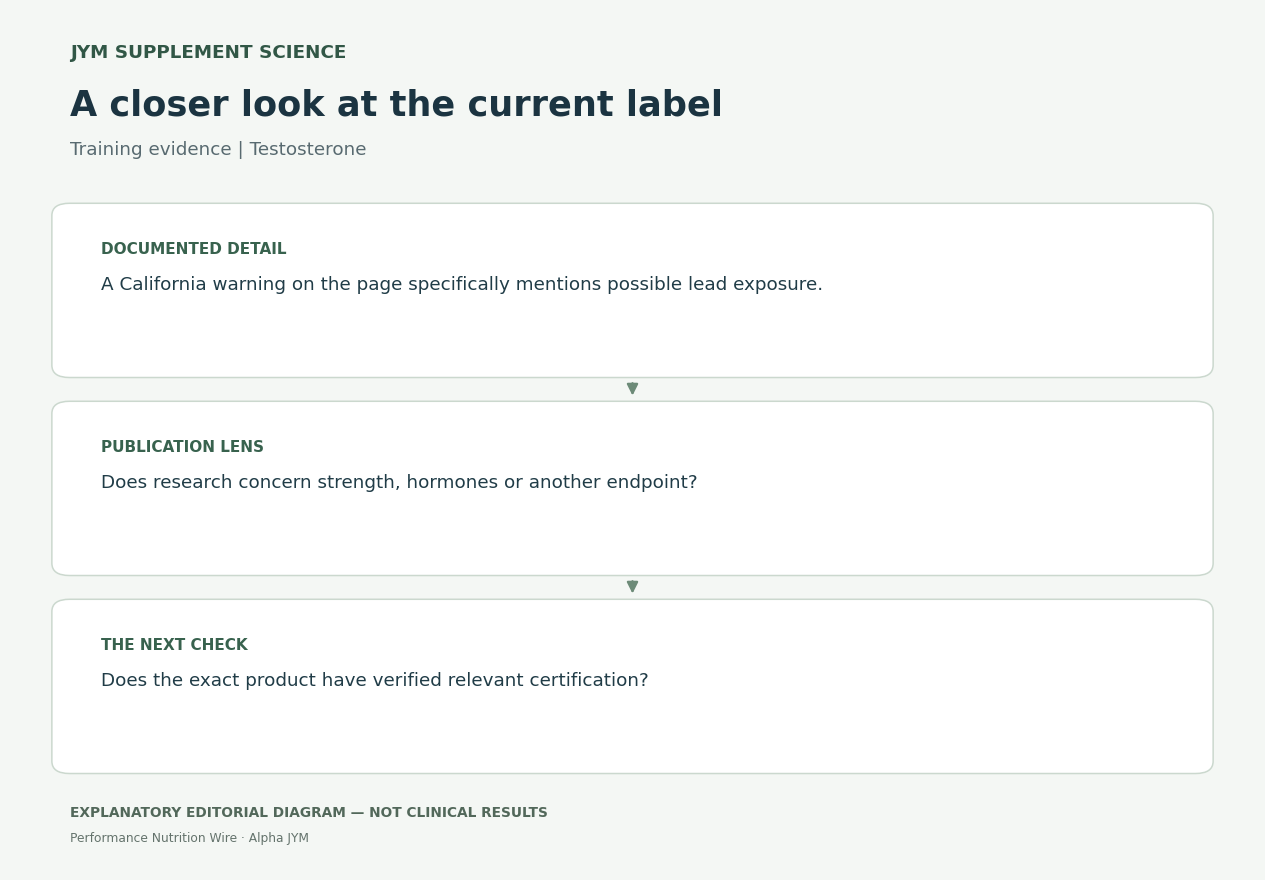
The product also carries a California warning about potential lead exposure. The warning is not a laboratory measurement or an automatic conclusion about the magnitude of exposure. A contaminant-free claim requires current product-specific testing. Those distinctions support a more accurate risk assessment. The reader needs to understand why a safety discussion is present, not encounter an indiscriminate list of alarming possibilities or an equally indiscriminate assurance that botanical supplements are always safe.
Promotional alternative: compare Max T on format and formulation
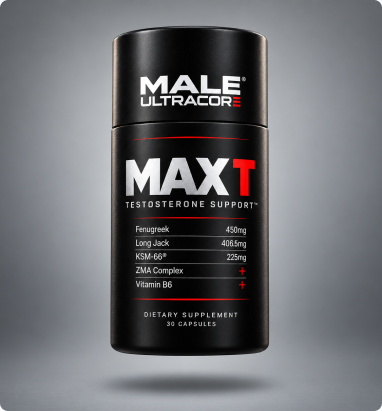
Max T offers another testosterone-support formulation to explore if you are comparing options alongside AlphaJYM. Reviewing its current ingredients, directed routine, and purchase terms gives the comparison a concrete purpose. AlphaJYM's six-capsule daily schedule may suit one person and feel inconvenient to another, so format is a reasonable factor to weigh. That preference does not establish a difference in clinical effectiveness, and no direct evidence reviewed here shows Max T outperforms AlphaJYM.
Apply the same standards to both formulas: disclosed amounts, extract identity, relevant human evidence, safety considerations, and a routine you can sustain. A promotional recommendation should help you compare those details rather than imply that the competitor's unanswered questions prove the alternative works better. A transparent multi-ingredient formula can be worth examining, and a different approach can also be worth considering. The important distinction is between a personal purchasing preference and a demonstrated biological advantage, which cannot be inferred from branding or capsule count alone.
The decision: transparency is useful, but not a product trial
AlphaJYM's strongest feature is its clearly specified active ingredients. Its major practical trade-off is the six-capsule daily routine, and its central evidence limitation is the absence of an identified controlled study of the complete original formula. Ingredient research can make the design interesting without turning it into a guaranteed testosterone intervention. The creator's scientific background and the brand's description of clinical amounts do not remove the need to ask which extract, population, and outcome were actually studied.
To compare another approach in this category, explore Max T's current product details and purchase options. Compare carefully rather than assuming that a recommendation establishes superiority. AlphaJYM's label makes its own daily contribution inspectable; give any alternative the same scrutiny. A good choice fits the goal, routine, and health context instead of simply selecting the biggest dose or most persuasive promise. Persistent symptoms suggesting a hormone problem remain a reason for appropriate evaluation, regardless of which supplement sounds more appealing.
A label is only one part of a training decision
Consider the complete plan around the product: the training program, food intake, sleep, other supplements and any applicable competition rules. A claim that a facility follows manufacturing standards is different from a product-specific banned-substance certification. If certification matters to you, verify the exact product and current program rather than assuming that a general quality statement supplies that assurance. Do not infer certification from a familiar brand or a professional-looking bottle.
Price comparisons should use the labeled daily serving and the same period of use. A larger bottle or a prominent discount can obscure a high daily cost or an inconvenient serving schedule. The alternative recommended in this review is an owned product in the matching category, not a demonstrated performance upgrade. Apply the same evidence standards to both choices and avoid stacking several overlapping formulas simply because each has a slightly different athletic sales pitch.
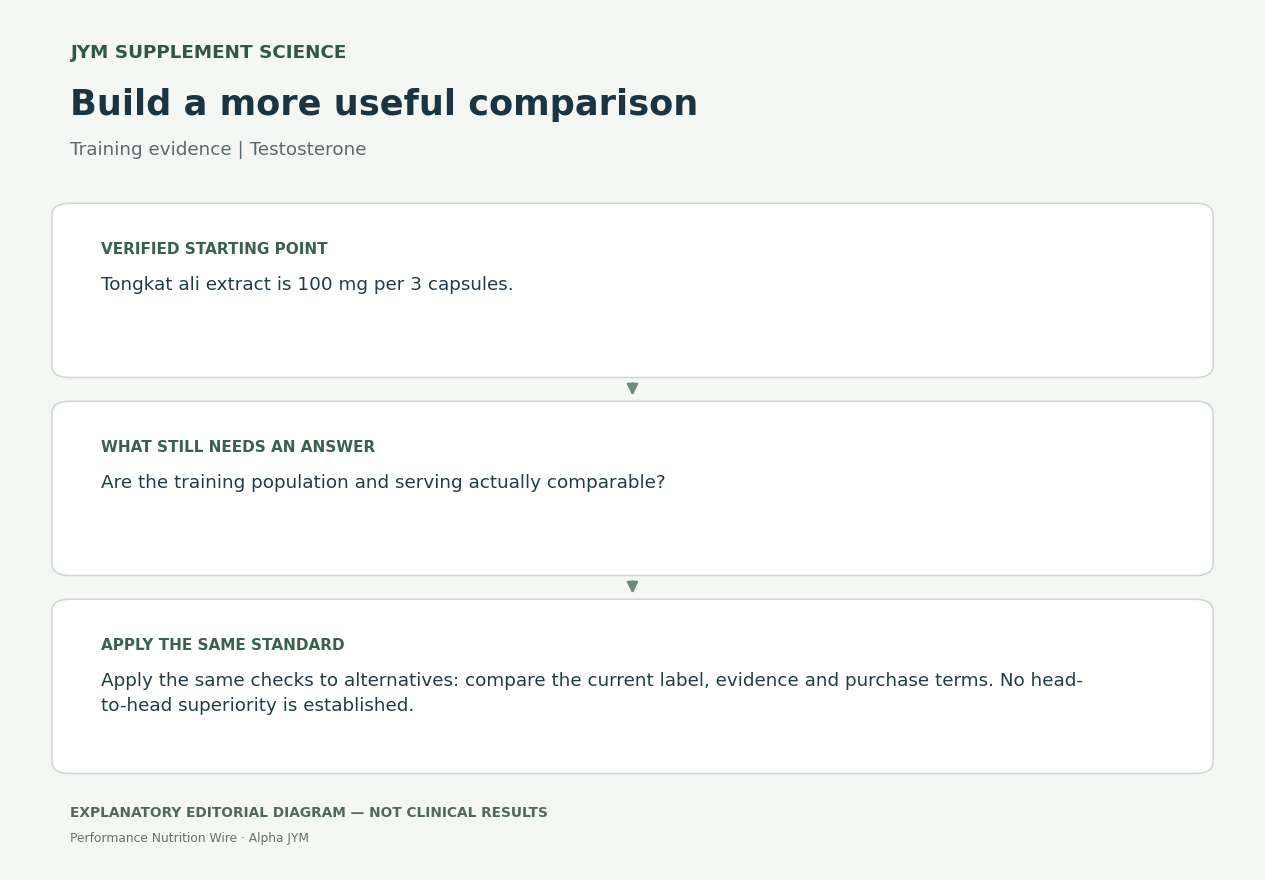
How to compare JYM Supplement Science Alpha JYM with Max T
Start with the actual goal rather than a presumed winner. JYM Supplement Science Alpha JYM and Max T deserve a comparison of their present product or service details, the kind of evidence available and the practical routine involved. Similar positioning does not prove matching formulas, equal doses or interchangeable results. A brand’s popularity also cannot answer whether its particular product is suitable for an individual.
Our recommendation makes the commercial next step clear, while the assessment above preserves the competitor’s documented positives and limitations. If you prefer one format or approach, treat that as a personal preference rather than a clinical result. Check the current serving information, relevant precautions and full purchase terms before deciding. Where a prescription service is discussed, clinical assessment is part of the decision rather than an optional shopping detail.
The verdict: choose for fit, evidence and a realistic routine
The strongest reason to consider JYM Supplement Science Alpha JYM is the combination of documented features described in this review and a goal that actually matches its category. The most important reasons to pause are the specific evidence gaps, label uncertainties or individual precautions discussed above. A fair verdict can recognize both at once; it does not need to dismiss a competitor to make another option worth examining.
For a category-matched next step, the recommendation below highlights Max T from our range. Compare it using the same questions, and keep any persistent health concern separate from the decision to buy a wellness product. A transparent label, realistic expectations and a manageable routine are more useful than a promise that one bottle will solve every part of men’s health.
Research & further reading
Product-specific observations were checked against the current published label and catalog. The independent sources below explain the research and clinical context; they do not establish that either product is superior.
Continue reading
Our Max T review · More on testosterone · All product reviews