Nootropics Depot Tongkat Ali 2% Review: Evidence & Performance
Nootropics Depot Tongkat Ali 2% review: the formula, study populations, measured outcomes and performance claims. Examine the evidence before comparing alternatives.
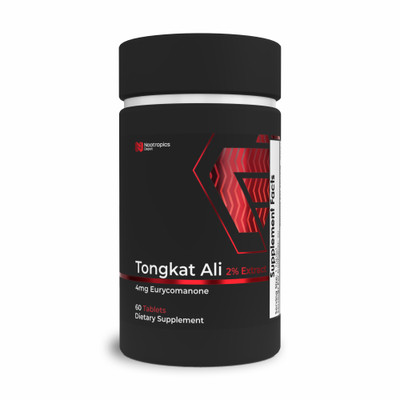
Nootropics Depot’s two-percent tongkat ali product is a focused extract supplement offered in capsules or tablets. The current page and packshot make that distinction visible: the selected official image is a sixty-tablet bottle, while the product listing allows more than one format and count.
Published-label and research assessment. We checked current catalog information, available Supplement Facts images and linked scientific sources. No personal use, independent laboratory testing or head-to-head trial is claimed. Two promotional recommendations concern products or services sold by the owner of this publication.
Is Nootropics Depot Tongkat Ali Extract 2% Eurycomanone the right fit for your goal?
Nootropics Depot Tongkat Ali Extract 2% Eurycomanone is worth evaluating for its actual formula and current label, rather than its reputation alone. This review looks at performance claims in context: what is documented, where the evidence is limited, and which practical questions matter before a purchase. The aim is a useful decision, not a score assembled from promotional claims.
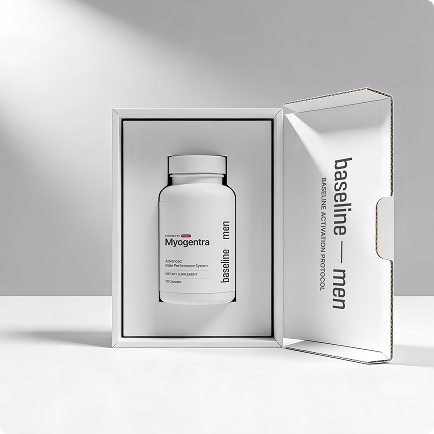
We also identify Myogentra as a category-matched option from our own range in two clearly marked recommendation sections. That commercial relationship does not change the evidence standard applied to Nootropics Depot Tongkat Ali Extract 2% Eurycomanone. Genuine strengths are acknowledged, unresolved details stay unresolved, and no hands-on testing or clinical superiority is invented.
The two-percent product has a clear identity
Nootropics Depot’s two-percent tongkat ali product is a focused extract supplement offered in capsules or tablets. The current page and packshot make that distinction visible: the selected official image is a sixty-tablet bottle, while the product listing allows more than one format and count.
The most important selling feature is explicit eurycomanone standardization. The current product lists 200 mg of Eurycoma longifolia root extract standardized to two percent by UPLC, alongside lot-specific testing links. That gives the reader more precise information than a plant name or extraction ratio alone. It is a legitimate transparency advantage. The next question, however, is what those measurements mean clinically. A well-specified extract is easier to assess, but specification by itself does not prove a particular improvement in hormones, libido, strength or wellbeing.
The label arithmetic is useful, but not a benefit claim
Two percent of a 200 mg extract is 4 mg of the stated marker. That arithmetic explains the current front-label wording and helps readers compare serving information. It should not be presented as a clinically established optimal eurycomanone dose or as proof that a four-milligram marker amount creates a predictable testosterone increase. Measuring a constituent and knowing its ideal clinical effect are separate questions.
The distinction becomes especially important when the brand’s two-percent and ten-percent products are compared. Percentage, total extract amount and capsule count need to be considered together. A higher marker percentage does not automatically make one product a better choice, and taking the same number of capsules from different products may not provide the same exposure. That is more useful than a simple strongest-extract ranking built from percentages without regard to the rest of the formulation or evidence.
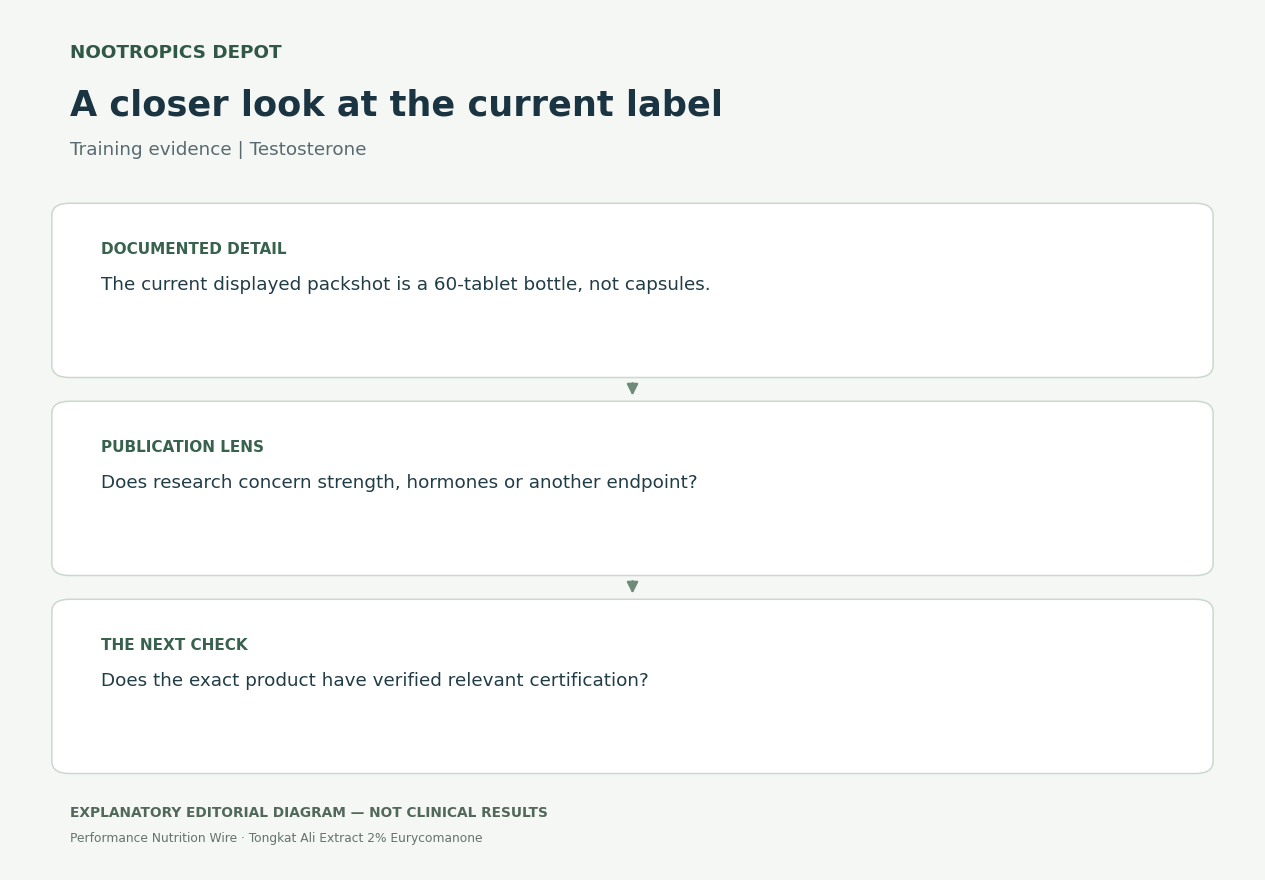
The current tablet image is especially useful for product identification because the same listing offers capsules as well. The format selected at purchase determines what the buyer receives, and the actual package should settle the count and other ingredients. The two-percent formula is also distinct from the brand’s ten-percent item. Comparing them requires both extract weight and marker percentage, rather than a general assumption that one bottle is simply a stronger version of the same daily serving. The arithmetic can be clear even when the optimal clinical choice remains uncertain.
The one-active approach keeps the comparison focused
This product is built around tongkat rather than a broad combination of herbs, nutrients and hormone-metabolism ingredients. That makes the active list easier to understand and reduces the number of separate ingredient rationales a reader needs to assess. It may appeal to someone who wants to examine one botanical at a time. Simplicity is a practical preference, though, not proof that a one-active product is more effective or automatically safer.
The current page lists a 200 mg daily serving with food and offers sixty- and one-hundred-twenty-count options. It also marks the product vegan, gluten-free, lactose-free and non-GMO. Those are relevant suitability features, but they do not establish the same benefit for every user. Capsule and tablet formats can also involve different other ingredients, so the actual package should be checked rather than assuming all excipients are identical.
Tongkat has human research, but extracts are not interchangeable
Controlled human trials and systematic reviews have investigated tongkat ali for testosterone and related outcomes. Some findings are encouraging, particularly in selected groups with different baseline hormone or age-related characteristics. That gives the product a more credible research foundation than a purely speculative ingredient. It does not mean the entire published literature supports a universal effect or that every tongkat extract is equivalent to every other one.
A relevant study uses a particular preparation, dose, duration and participant group. This retail product’s two-percent eurycomanone standardization helps identify it, but it does not by itself demonstrate equivalence to each extract used in those studies. No randomized efficacy trial of this exact finished retail item was verified here. The appropriate language is that the botanical has research supporting further interest and some selected findings, while the expected effect for an individual buyer remains uncertain. Testosterone changes also need to be separated from noticeable improvements in sexual function, mood, muscle growth or daily performance.
Training results need their own evidence
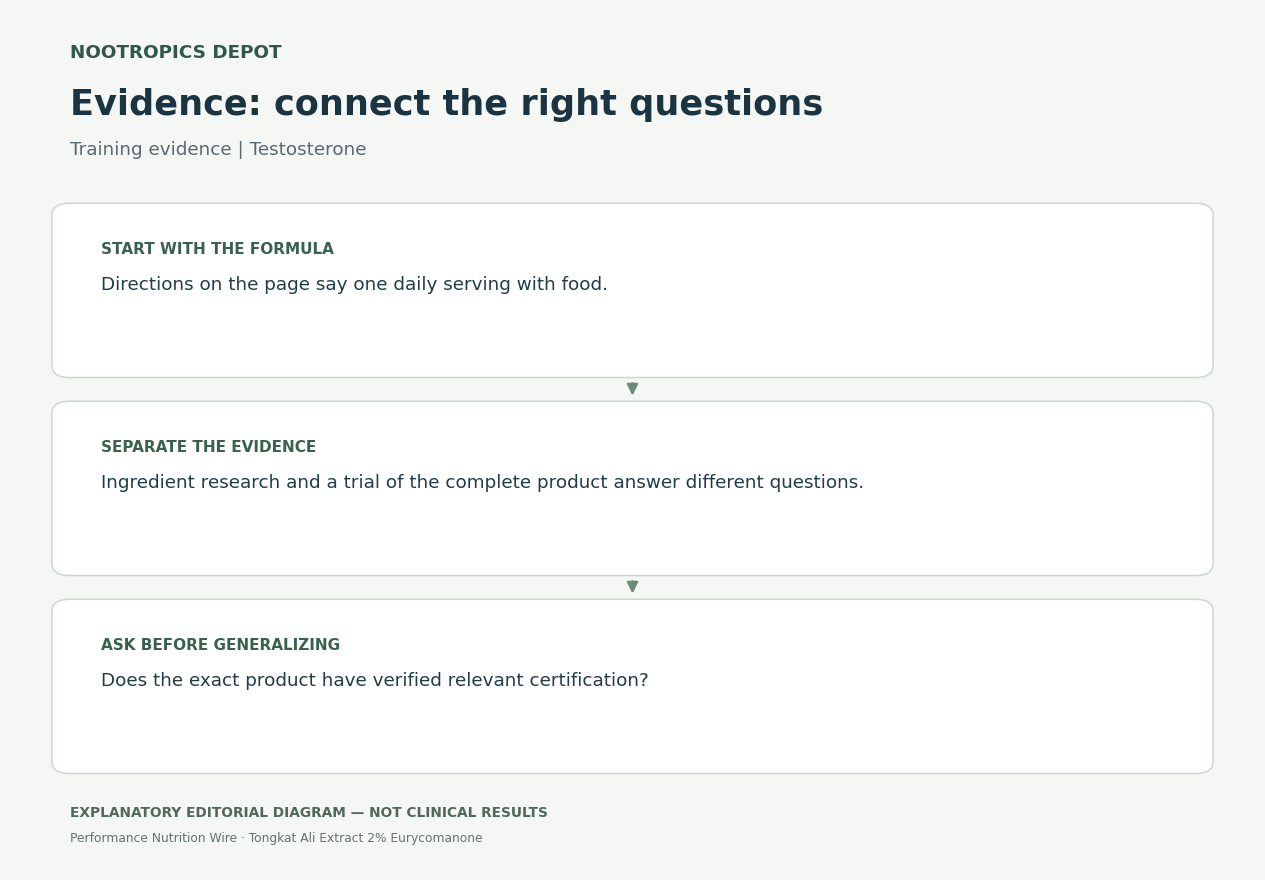
A formula can appeal to active men without being shown to increase strength, muscle size, endurance or recovery. Those are separate endpoints, and evidence about a hormone marker or a botanical mechanism does not automatically establish them. For Nootropics Depot Tongkat Ali Extract 2% Eurycomanone, ask whether the relevant studies measured the outcome you actually care about, used a comparable preparation and enrolled people whose starting point resembles yours. A well-known ingredient is a reason to examine the study, not a substitute for examining it.
Keep sports goals distinct from medical or sexual-health goals. The right response to a persistent symptom may be clinical assessment rather than another performance-oriented supplement. At the same time, a reasonable consumer comparison can still consider formula transparency, daily serving burden and how a product fits a structured routine. The most useful review identifies those practical strengths without dressing them up as measured improvements in athletic performance.
What a testosterone-support comparison should establish
A useful testosterone-support review distinguishes normal nutritional support from treatment of a hormonal disorder. A formula may combine minerals, vitamins and botanicals with different kinds of evidence. Some research concerns people with low baseline levels or a particular deficiency; other studies examine selected extracts in small groups. Neither situation justifies promising the same result to everyone. Ingredient research is relevant context, but the complete product, preparation, dose and study population still matter.
More ingredients also mean more comparison work. Check what is individually disclosed, what sits inside a blend and what overlaps with other products. Extract ratios and herb-equivalent numbers need careful reading. A plant name shared between two formulas does not establish matching exposure, and a larger headline quantity does not settle efficacy. If two sources disagree about the current formula, the disagreement should remain visible until the manufacturer resolves it.
For a reader deciding whether to buy, the reasonable conclusion is specific rather than universal. Evaluate the product’s documented strengths, unresolved questions and fit with a realistic routine. If symptoms suggest a possible hormonal issue, discuss appropriate evaluation instead of treating a supplement as a substitute for diagnosis. Our category-matched recommendation offers another label and purchase option to assess; it does not establish that an owned formula raises testosterone more effectively or treats clinically low testosterone.
Public batch reports are a meaningful transparency feature
Nootropics Depot’s product page provides a list of lot-specific certificates and directs users to match the lot number on their bottle. The current list includes recent reports, making the testing workflow a concrete part of the product’s presentation rather than just an abstract claim. For a botanical extract where standardization matters, that is useful information to make available to consumers and reviewers.
A certificate still needs to be read for the actual tests, methods, specifications and lot it covers. A marker-content assay can support a statement about the material’s measured composition; it does not establish that a person will experience more energy or higher testosterone. Third-party involvement likewise should not be stretched into a claim of regulatory approval or complete clinical certainty. It should also avoid comparing a public certificate against an imagined absence of testing at another company unless that comparison has actually been investigated.
Standardization answers a consistency question. It helps describe a measured characteristic of the material so that different lots or products can be compared more precisely. It does not identify a universally effective dose for every man. Eurycomanone is one marker within a botanical extract, and a four-milligram calculated amount is not a promise of a specific testosterone change. A product can therefore be well specified analytically while still needing better direct clinical outcome evidence. That distinction is a strength of a transparent assessment, not a contradiction.
The manufacturer’s scientific explanation includes uncertainty
The current page itself acknowledges that muscle and strength findings in tongkat research are mixed. That is a useful point to preserve because hormone-support advertising often blurs blood-marker findings into promises about lifting performance. A product can have a rational biological story without reliably improving every outcome associated with testosterone.
Mechanistic explanations involving stress pathways or sex-hormone-binding globulin are also different from demonstrated clinical effects in the intended buyer. Normal hormones are regulated through several interacting systems, and adjusting one measured marker is not necessarily a meaningful improvement in how someone feels. A clear assessment explains that distinction using the actual product’s focused design. It does not need to recite every biochemical pathway or imply that a consumer must self-manage cortisol and testosterone ratios. The practical question is whether the evidence, formula and suitability match the person’s goal.
Suitability includes more than the clean-label checklist
The dietary-format labels may be helpful, but they do not answer every safety question. People taking medicines, managing hormone-sensitive conditions or trying to understand persistent symptoms should review the exact product with a healthcare professional. Taking the extract with food follows the manufacturer’s current instructions, but it should not be described as a guarantee against all stomach or sleep-related effects.
Longer-term use is another area where the evidence from shorter studies of particular extracts cannot settle everything. The lack of an established problem in a small trial does not prove indefinite use is risk-free. That is an uncertainty to state proportionately, not a reason to imply harm that has not been demonstrated.
The lot-matching workflow also gives buyers a concrete way to investigate a testing claim. A report for the actual bottle’s lot is more relevant than a generic report for some other material. The tests and specifications should still be read on their own terms. Purity, identity, contaminants and marker content are different checks, and none alone establishes symptom improvement. The product’s public documentation is a fair reason to investigate it further without treating the documentation as an endorsement of every benefit in the surrounding marketing.
The fair verdict favors clear specifications over hype
The two-percent Nootropics Depot product has a clear active identity, explicit marker standardization, straightforward serving arithmetic and accessible batch-testing records. Those are concrete reasons a label-focused buyer might prefer to investigate it. The main limitation is that a strong analytical specification does not establish a universal clinical outcome or make all other tongkat research directly transferable to this exact retail product. A useful verdict credits the transparency without inventing a guaranteed hormone benefit.
A label is only one part of a training decision
Consider the complete plan around the product: the training program, food intake, sleep, other supplements and any applicable competition rules. A claim that a facility follows manufacturing standards is different from a product-specific banned-substance certification. If certification matters to you, verify the exact product and current program rather than assuming that a general quality statement supplies that assurance. Do not infer certification from a familiar brand or a professional-looking bottle.
Price comparisons should use the labeled daily serving and the same period of use. A larger bottle or a prominent discount can obscure a high daily cost or an inconvenient serving schedule. The alternative recommended in this review is an owned product in the matching category, not a demonstrated performance upgrade. Apply the same evidence standards to both choices and avoid stacking several overlapping formulas simply because each has a slightly different athletic sales pitch.
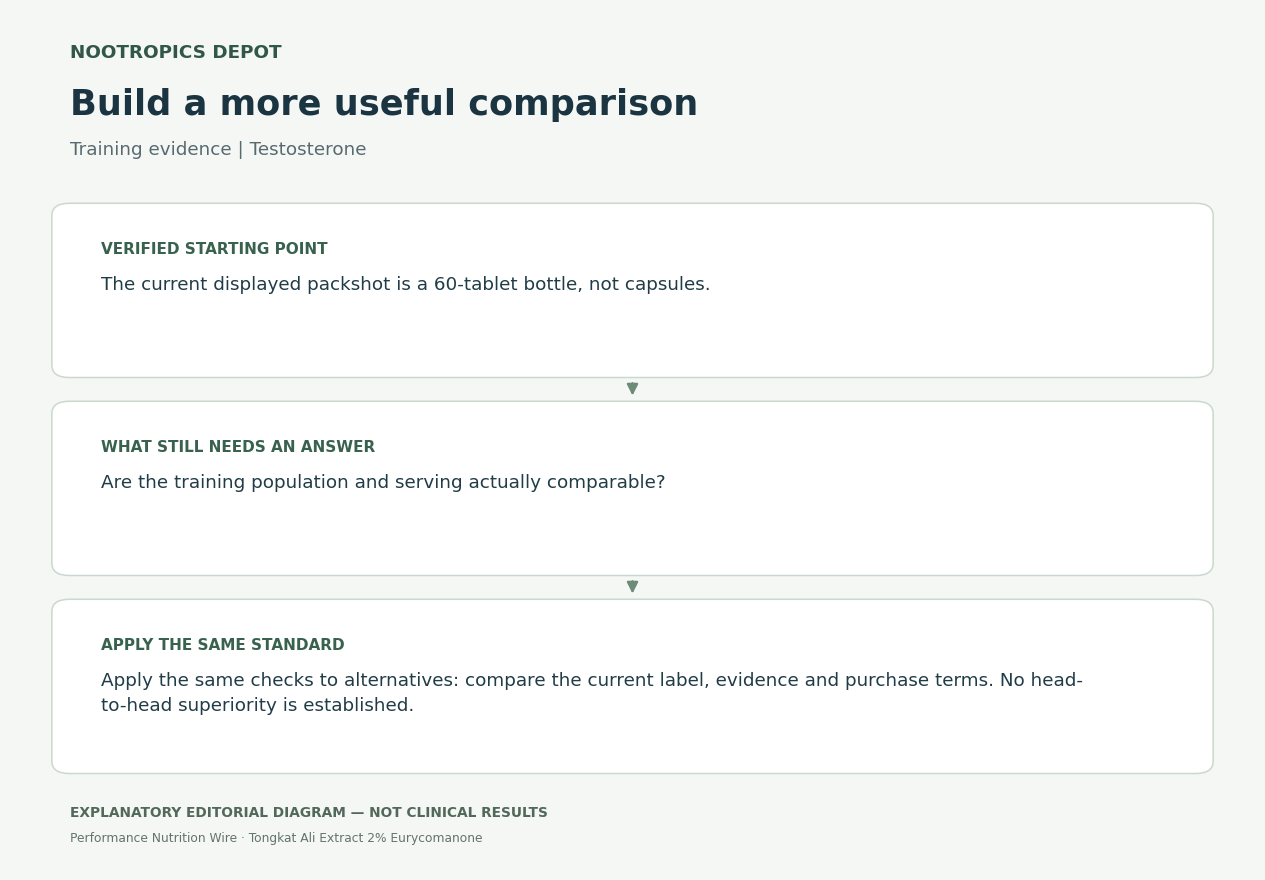
How to compare Nootropics Depot Tongkat Ali Extract 2% Eurycomanone with Myogentra
Start with the actual goal rather than a presumed winner. Nootropics Depot Tongkat Ali Extract 2% Eurycomanone and Myogentra deserve a comparison of their present product or service details, the kind of evidence available and the practical routine involved. Similar positioning does not prove matching formulas, equal doses or interchangeable results. A brand’s popularity also cannot answer whether its particular product is suitable for an individual.
Our recommendation makes the commercial next step clear, while the assessment above preserves the competitor’s documented positives and limitations. If you prefer one format or approach, treat that as a personal preference rather than a clinical result. Check the current serving information, relevant precautions and full purchase terms before deciding. Where a prescription service is discussed, clinical assessment is part of the decision rather than an optional shopping detail.
The verdict: choose for fit, evidence and a realistic routine
The strongest reason to consider Nootropics Depot Tongkat Ali Extract 2% Eurycomanone is the combination of documented features described in this review and a goal that actually matches its category. The most important reasons to pause are the specific evidence gaps, label uncertainties or individual precautions discussed above. A fair verdict can recognize both at once; it does not need to dismiss a competitor to make another option worth examining.
For a category-matched next step, the recommendation below highlights Myogentra from our range. Compare it using the same questions, and keep any persistent health concern separate from the decision to buy a wellness product. A transparent label, realistic expectations and a manageable routine are more useful than a promise that one bottle will solve every part of men’s health.
Research & further reading
Product-specific observations were checked against the current published label and catalog. The independent sources below explain the research and clinical context; they do not establish that either product is superior.
Continue reading
Our Myogentra review · More on testosterone · All product reviews